Why rated speed and real output differ
A filling machine rated at 80 units per minute should theoretically produce 4,800 units per hour. Yet many food manufacturers see significantly less saleable output at the end of the packaging line. The difference isn't necessarily a faulty machine. It often comes from short stops, mismatched equipment speeds, product handling, changeovers, and the way individual stations work together.
The most useful question isn't “How fast is the filler?” It's “How many good, finished packs can the entire line produce consistently under normal operating conditions?”
Rated machine speed is not the same as line throughput
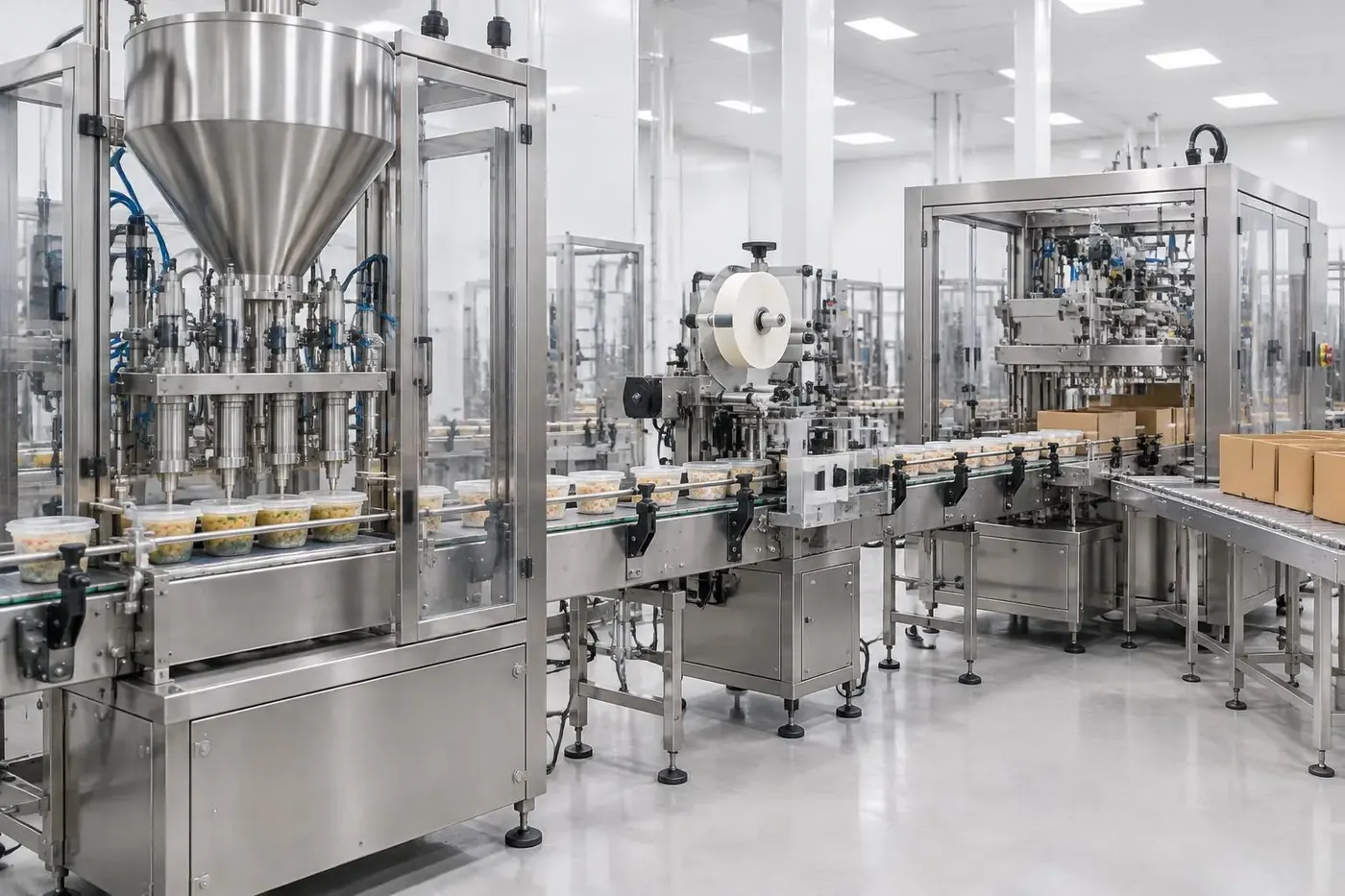
A machine's rated speed describes what it can achieve under defined conditions. A packaging line involves much more: infeed, denesting, filling, sealing, coding, weighing, inspection, case packing and palletizing. Each stage introduces possible interruptions or restrictions.
For example, an 80-unit/minute filler discharging into a case packer that can consistently handle only 60 units per minute will not create an 80-unit/minute finished-goods line. Even if you add an accumulation conveyor, the downstream machine is still the sustained bottleneck. The buffer only absorbs temporary differences between stations.
Rated capacity, stable running speed, and actual good output should therefore be measured separately.
A practical example: 80 units/minute vs. actual output
Consider an illustrative line rated for 80 units per minute, running over a one-hour production window:
Good finished output = 4,800 × 0.75 × 0.95 × 0.98 = approximately 3,352 packs/hour, or about 56 good packs per scheduled minute. This equals about 70% of the theoretical hourly capacity. These percentages are purely illustrative, not industry averages or measured Pure customer results.
This is why planning a line solely from its highest advertised cycles-per-minute figure can produce unrealistic staffing, labor-saving, and ROI projections.
- Ideal theoretical output: 80 × 60 = 4,800 units/hour
- Equipment availability: 75% after short stops, clearing jams, and other production interruptions
- Running performance: 95% of the ideal rate while equipment is operating
- Quality yield: 98% of packs pass inspection
Five common reasons production lines underperform
1. The slowest station determines sustained capacity
If filling is 80 units/minute but sealing, inspection, case packing, or palletizing cannot maintain the same pace, the line will eventually back up or starve. Evaluate sustained rates with the actual product and package, not only rated machine speeds.
2. Micro-stops add up
A container that fails to denest, an inconsistent pouch pickup, a label misfeed, or a case that needs manual correction may cause only a few seconds of downtime. Repeated dozens of times per shift, those events meaningfully reduce throughput. Track the frequency and root cause, not just the longest breakdowns.
3. Product and packaging variation affect performance
Sticky or particulate foods, irregular product geometry, inconsistent trays or cups, flexible packaging variation, and changing fill weights can all reduce repeatability. The packaging material and difficult product variants should be tested under realistic operating conditions.
4. Changeovers, sanitation, and recovery time matter
A line that runs multiple SKUs may lose more capacity to tooling changes, recipe setup, washdown, sanitation, and startup stabilization than to headline machine speed. Choose accessible equipment, repeatable settings, and practical changeover designs when comparing solutions.
5. Poor coordination between machines creates avoidable stops
Machine-to-machine handshakes, infeed metering, accumulation control, reject handling, and line-speed coordination determine whether equipment works as one system. An isolated upgrade may simply move the bottleneck downstream.
What should you improve first?
Start with a real production study. Record good finished packs per hour at the end of the line, operating and downtime minutes, reject causes, actual running rate, and the SKU being processed. Break short stops into categories: feeding, sealing, downstream backup, inspection rejects, case handling and so on.
Next, address the constraint with the highest impact. Sometimes that means more consistent product feeding or a better case handling arrangement rather than buying a faster filler. Where interruptions are temporary and upstream/downstream rates differ, correctly sized accumulation can prevent one short stop from shutting down the entire line. When one station is permanently slower, additional buffer alone cannot solve that sustained capacity constraint.
If expansion is planned, build some capacity headroom into the architecture and specify how new equipment will communicate with the machines you already have. Validate the full system during factory acceptance testing with the actual containers, products and packaging materials—including the worst-case formats, not just the easiest ones.
What to ask before investing in a packaging line
Ask equipment suppliers to distinguish between maximum mechanical speed, guaranteed sustained throughput under agreed conditions, and expected good output over a defined production period. Confirm which SKUs were tested, expected changeover times, sanitation assumptions, upstream/downstream responsibilities, reject handling, utilities, operator requirements and commissioning criteria.
That creates a more reliable basis for comparing turnkey packaging systems and modular upgrades.
Better line design starts with the complete process
Packaging line efficiency comes from getting the whole process to perform consistently. Filling, sealing, inspection, labeling, case packing, palletizing and accumulation should be planned as connected systems rather than independent machines.
Pure Packaging Solutions helps U.S. and Canadian manufacturers evaluate complete packaging lines and individual automation upgrades. To discuss your application, share your product, package format, current good output, target rate, SKU changes and available floor space. We can help identify the practical next step.
Frequently asked questions
Does an 80-unit/minute rating mean 4,800 finished packs every hour? No. That is theoretical maximum production before downtime, slower operation, product rejects and downstream losses.
Can an accumulation conveyor fix a slow packaging machine? Accumulation can absorb brief interruptions and differences in timing. It cannot raise the sustained capacity of an undersized downstream machine.
Where should packaging line throughput be measured? For commercial planning, measure saleable, finished output at the appropriate end-of-line point, over a defined shift or production window, in addition to individual machine speeds.