
Solutions
Cup Filling and Sealing Machines
Complete cup-filling and sealing systems, configured to your product, container and production rate — with support from machine selection through line integration.
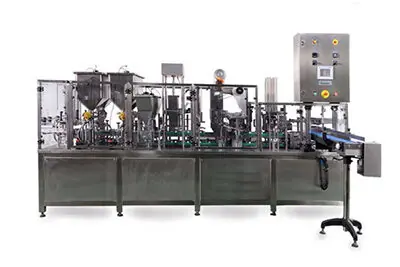
Automatic filling and sealing for preformed cups
Cup filling and sealing machines dose product into preformed cups and close them with a heat-sealed film or foil lid, with snap-on overcaps where the package calls for one. They are built for food, beverage and consumer-product manufacturers — dairy and yogurt producers, sauce and dip manufacturers, ready-meal producers, dessert and snack makers, beverage producers and contract packagers.
The right configuration depends on your product characteristics, container format, closure and required throughput. This page explains the available systems and helps you choose; the individual machine pages carry the technical detail.
Configurations
Choose the right machine configuration
Three equipment families cover the range from entry-level automation to continuous high-output production.
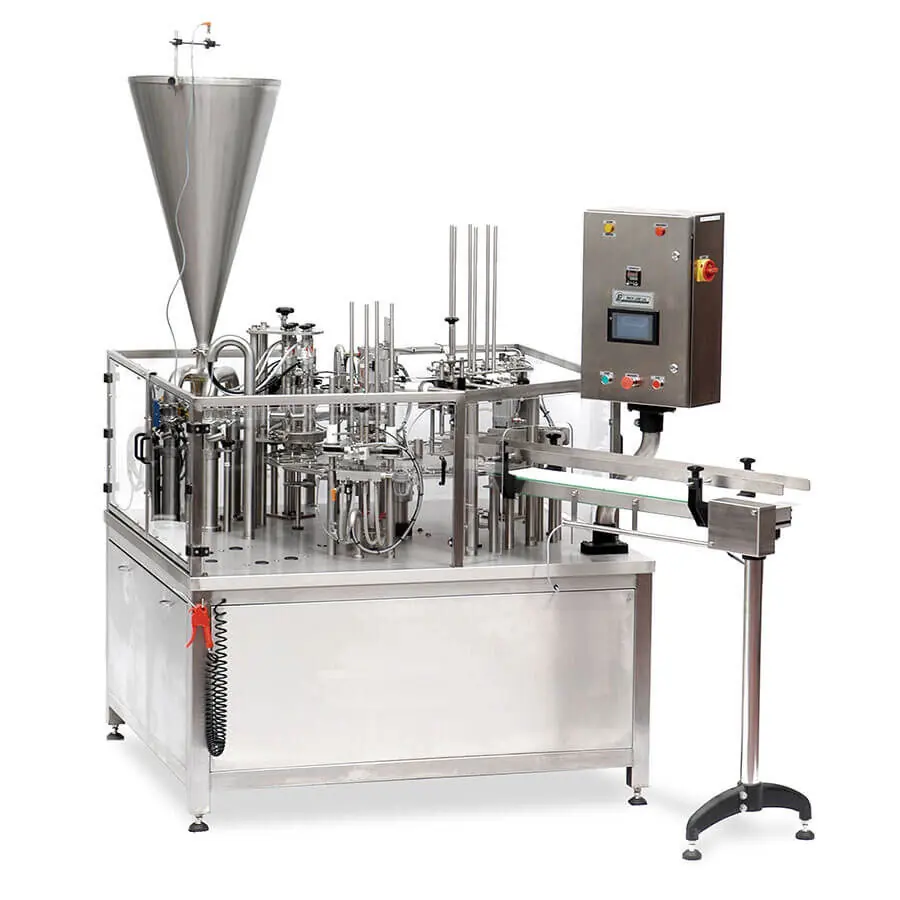
Rotary cup filling machines
Higher-output applications and compact continuous production on a small number of formats.
View Rotary cup filling machines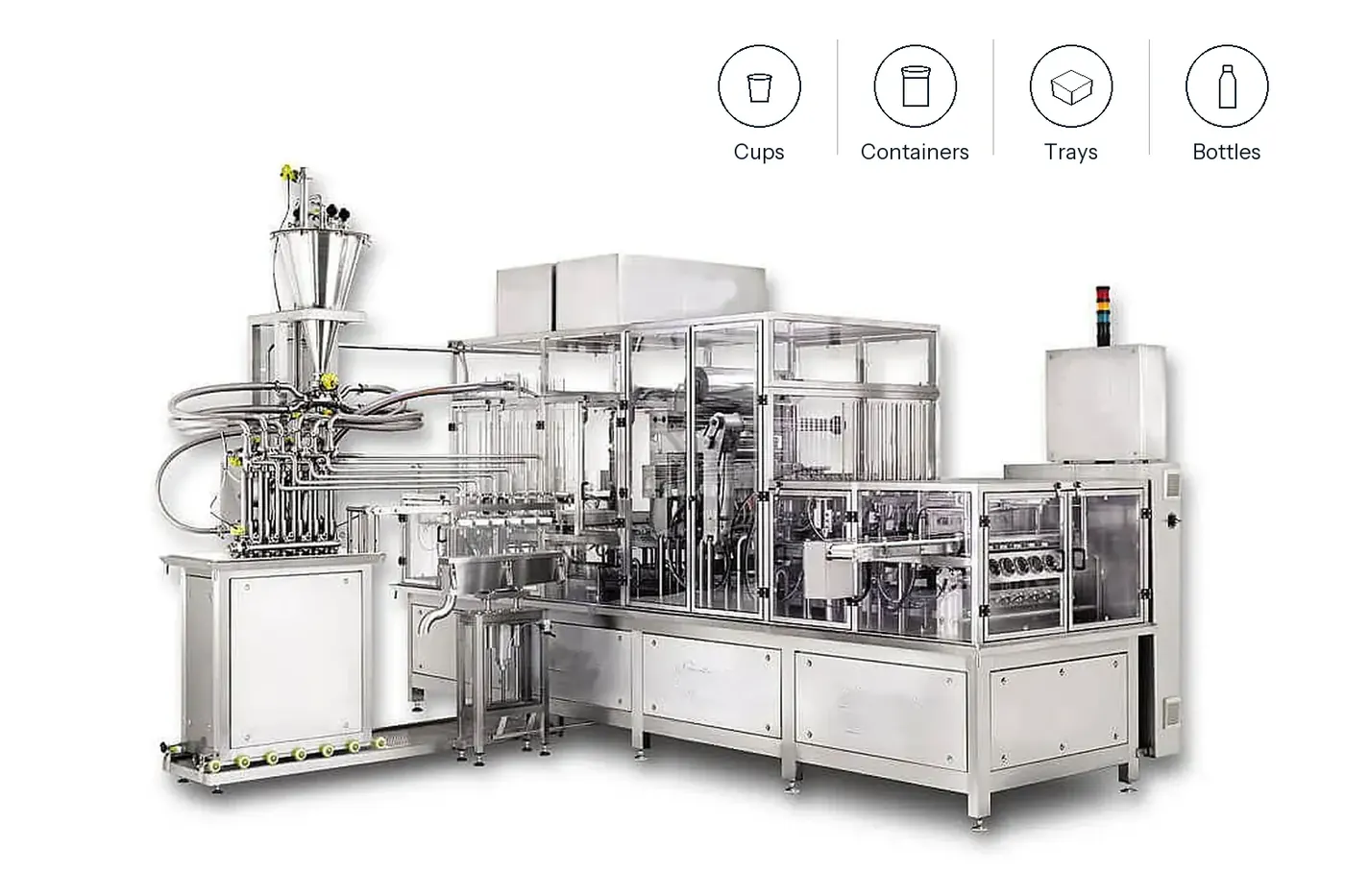
Inline servo filling and sealing systems
Flexible, controlled filling across multiple lanes or formats with accurate, repeatable motion control.
View Inline servo filling and sealing systemsPneumatic cup filling machines
Simpler applications or lower production requirements, and producers moving from manual packing into automation.
View Pneumatic cup filling machinesApplications
Products and applications
Each product brings its own filling challenge — viscosity, particulates, foaming, temperature, hygiene and seal integrity all shape the machine configuration.
Yogurt and cultured dairy
Viscous and semi-viscous products need controlled dosing for fill accuracy, hygienic product contact surfaces and reliable seal integrity for chilled distribution.
Sauces, dips and condiments
Products with particulates or higher viscosity call for filling technology matched to the product, plus change parts when several recipes or cup sizes run on one machine.
Prepared foods and ready meals
Hot or cold filled components require attention to product temperature, fill accuracy and seal integrity, often with date coding and downstream case packing.
Desserts and snacks
Layered, aerated or foam-prone products need dosing that protects appearance and portion weight, with clean cutoff at the fill nozzle.
Beverages and liquid products
Free-flowing liquids fill quickly but can foam or splash; the filling method and cycle timing are matched to the product and target output.
Packaging Formats
Cup and closure options
Systems are tooled around your container. Compatibility is confirmed during the application review.
- Preformed cups in a range of materials and dimensions
- Roll-fed film sealing
- Pre-cut foil or film lids
- Snap-on lids and optional overcaps
- Printed or registered sealing material
How It Works
The filling and sealing process
A typical operating sequence, from empty cup to finished package.
- 1Cup denesting and placement
- 2Product dosing
- 3Optional treatment or additional stations
- 4Seal placement
- 5Heat sealing
- 6Lid placement, if applicable
- 7Discharge or downstream handling
Options
Available options and integration
Cup filling and sealing rarely stands alone. These options connect it to the rest of your line.
- Multiple filling technologies matched to the product
- Servo-controlled dosing
- Date or lot coding
- Inspection and rejection
- Labeling
- Conveyors and product handling
- Case packing
- Complete line integration
Buyer's Checklist
How to select a system
Work through these points before requesting a quotation — they are exactly what our engineers will ask about.
- Product characteristics — viscosity, particulates, temperature, foaming
- Cup dimensions and material
- Seal or closure type — film, pre-cut lid, snap-on lid
- Required containers per minute
- Number of recipes or formats
- Changeover frequency
- Cleaning and hygiene requirements
- Available floor space
- Upstream and downstream equipment
- Required inspections or coding
One Partner
Why Pure Packaging Solutions
Pure engineers, specifies, supplies and integrates packaging automation — and stays accountable from concept through service.
- Application review before any equipment is proposed
- Equipment selection matched to product, container and rate
- Line integration with upstream and downstream equipment
- Installation and commissioning
- Operator training
- Parts and service support
Related Equipment
Explore the machines behind this solution
Cup filling and sealing questions
What products can a cup filling and sealing machine handle?
Dairy and cultured products, sauces, dips, prepared foods, desserts, beverages and similar products filled into preformed cups. The right filling technology depends on viscosity, particulates, temperature and hygiene requirements, which is why every project starts with an application review.
What is the difference between rotary and inline cup-filling systems?
Rotary systems run continuously on a compact carousel and suit higher-output production on a small number of formats. Inline systems index cups along a straight path, which makes them flexible across multiple lanes, formats and additional stations.
How do I determine the required production speed?
Start from your sales volume and available production hours, then add headroom for growth. Speed also depends on cup size and configuration — for example, on a rotary machine, smaller cups running several-up reach higher outputs per minute than large cups running fewer-up. Share your target rate and cup sizes and we will match a configuration to them.
Can one machine handle multiple cup sizes?
Yes, with change parts. Machines can be tooled for several cup dimensions, and changeover time depends on how different the formats are. Tell us your cup sizes and how often you switch, and we will confirm the changeover scope.
What sealing materials can be used?
Roll-fed film or pre-cut foil and film lids, with snap-on overcaps where the package calls for one. Seal material is chosen with the cup material and product in mind to get reliable seal integrity.
Can cup filling equipment be integrated into a complete packaging line?
Yes. Cup filling and sealing typically sits between upstream product preparation and downstream coding, inspection, case packing and palletizing. Pure engineers and integrates the complete line so the sections work as one system.
What information is needed to receive a quotation?
Your product, cup dimensions and material, seal or closure type, desired production rate, number of formats, your current process and your target installation date. The request form below walks you through each item.
Tell us about your cup-filling application
Share your product, cup dimensions, closure type, desired production rate, number of formats, current process and target installation date — and our engineers will come back with a matched configuration and pricing.