What must the packer handle on an ordinary shift?
Start with a product and case matrix, not a machine brochure.
List every product and shipping case the system must run, including pack counts, orientations, dividers and allowable contact surfaces. Record actual dimensions and variation, not just nominal drawing values. A flexible pouch, a slippery bottle and a carton with an uneven closure present different handling problems, even when they fit the same case.
Include the conditions under which products arrive. Dairy containers may carry condensation. Personal care bottles may have vulnerable pumps or decorative surfaces. Food packages may shift as their contents settle. Identify whether the package can tolerate gripping, pushing, lifting or contact with neighboring products.
Then separate launch requirements from possible future formats. Ask suppliers to identify what each additional format changes in tooling, controls, guarding and footprint. Buying flexibility without defining it often produces an expensive machine that still needs substantial modifications for the next launch.
Which loading method suits the package, rather than just the layout?
Top loading, side loading and drop packing place different demands on product stability and case presentation. Evaluate the complete motion from infeed through placement. A package that stands reliably on a conveyor may tip during grouping, while a product that survives a short drop may still suffer unacceptable cosmetic damage.
For pick and place handling, ask how the tooling manages dimensional variation, missing products and partial picks. For push or drop arrangements, examine friction, guide transitions and impact. Request trials using representative production samples, including difficult variants, rather than accepting a demonstration with convenient substitutes.
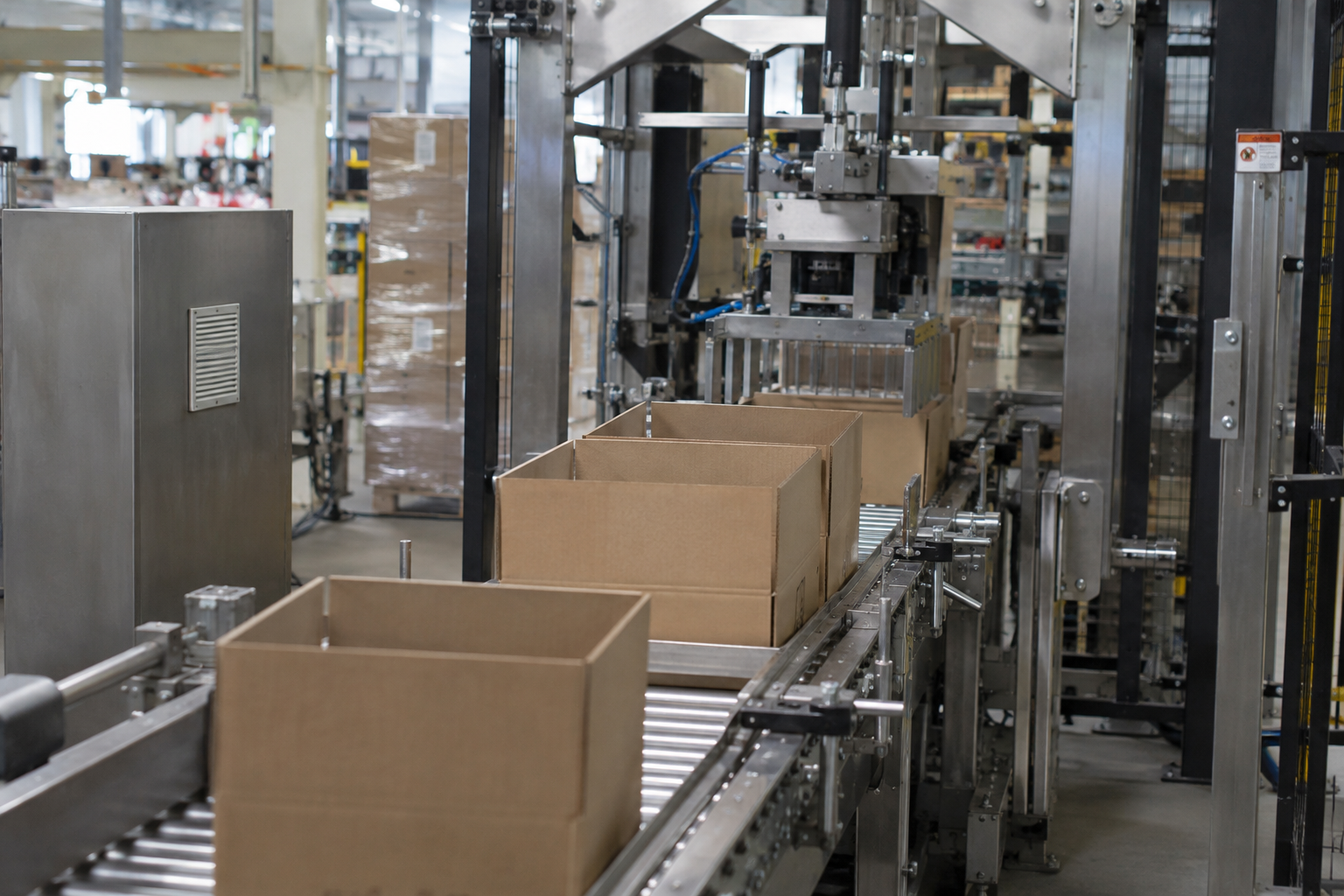
Give corrugated cases equal attention. Board stiffness, score quality, flap position and squareness affect loading. If case erecting is included, establish who supplies and verifies the erected case dimensions. A loading fault can originate well before the product reaches the packing station.
How will the system behave when the rest of the line hesitates?
Specify recovery behavior alongside capacity.
Define the required output by product and pack pattern, then compare it with upstream delivery and downstream acceptance. Average production alone is not enough. Short bursts, product gaps, case replenishment and downstream stops determine whether the packer needs accumulation or controlled pauses.
Walk through a downstream blockage and an upstream interruption with the supplier. Where does product wait? What prevents damage during accumulation? How are incomplete groups or partially filled cases handled on restart? Agree on interface signals and responsibility for adjoining conveyors. A machine boundary on a quotation should not become an unresolved control boundary on the plant floor.
Can operators change, clean and recover it safely?
Evaluate changeovers as a sequence of physical tasks. Identify adjustments, removable tooling, recipe selections and verification steps. Ask an operator to explain how the correct format is confirmed before production resumes. Stored settings help, but they do not prove that guides or grippers are installed correctly.
Match construction and access to the cleaning method and exposure at the installation location. Do not assume that equipment near a washdown area is suitable for direct washdown. Review drainage, residue traps, lubrication access and cleaning chemical compatibility where relevant. For pharmaceutical applications, define applicable documentation and validation expectations early.
Review routine jam locations with maintenance and safety personnel. Recovery should not depend on awkward reaching or defeating safeguards. Establish safe access and energy isolation provisions before approving the layout.
What should every shortlisted supplier answer?
Use the same checklist for each proposal.
Require written answers tied to your application. Where an answer depends on testing, record the open item and the evidence needed to close it.
- Which products, case styles and pack patterns are included, and which require additional tooling or trials?
- What sustained output is proposed for each format, and under what product supply and downstream conditions?
- How are missing products, incomplete cases and damaged packages detected and handled?
- What operator tasks are required for replenishment, changeover, cleaning and normal fault recovery?
- Who owns conveyor interfaces, control signals, utilities and installation work?
- What acceptance tests, training, spare parts and support provisions are included?
What evidence will authorize shipment and final acceptance?
Build the acceptance plan before placing the order. Specify representative materials, difficult formats, run conditions, changeovers and fault recovery demonstrations. Define acceptable product condition and case quality, as well as output. Distinguish factory testing from site acceptance, where actual conveyors, operators and production conditions become part of the test.
Keep unresolved items on a shared action list with owners and closure criteria. For an application review, visit the Pure Packaging Solutions [Case Packing Systems page](/solutions#case-packing-systems) or request a quote. Bring your product matrix, layout and proposed acceptance criteria so the discussion starts with the work the equipment must perform.