Start with the handling task, not the robot
The right handling approach depends on what arrives at the station and what must leave it. Individual products moving on a conveyor present a different problem from products ready to enter a distribution case. Finished cases heading toward a pallet present another. Define the product condition, required orientation and destination first. Then compare equipment around that task rather than treating every robotic application as interchangeable.
There is no universal winner among these four approaches. Performance depends on the product, format and configuration, including how consistently the upstream equipment presents the load. The comparisons below identify sensible starting points, not guaranteed capabilities. Use them to build a specification that includes awkward products, routine changeovers, cleaning access and the handoffs between machines.
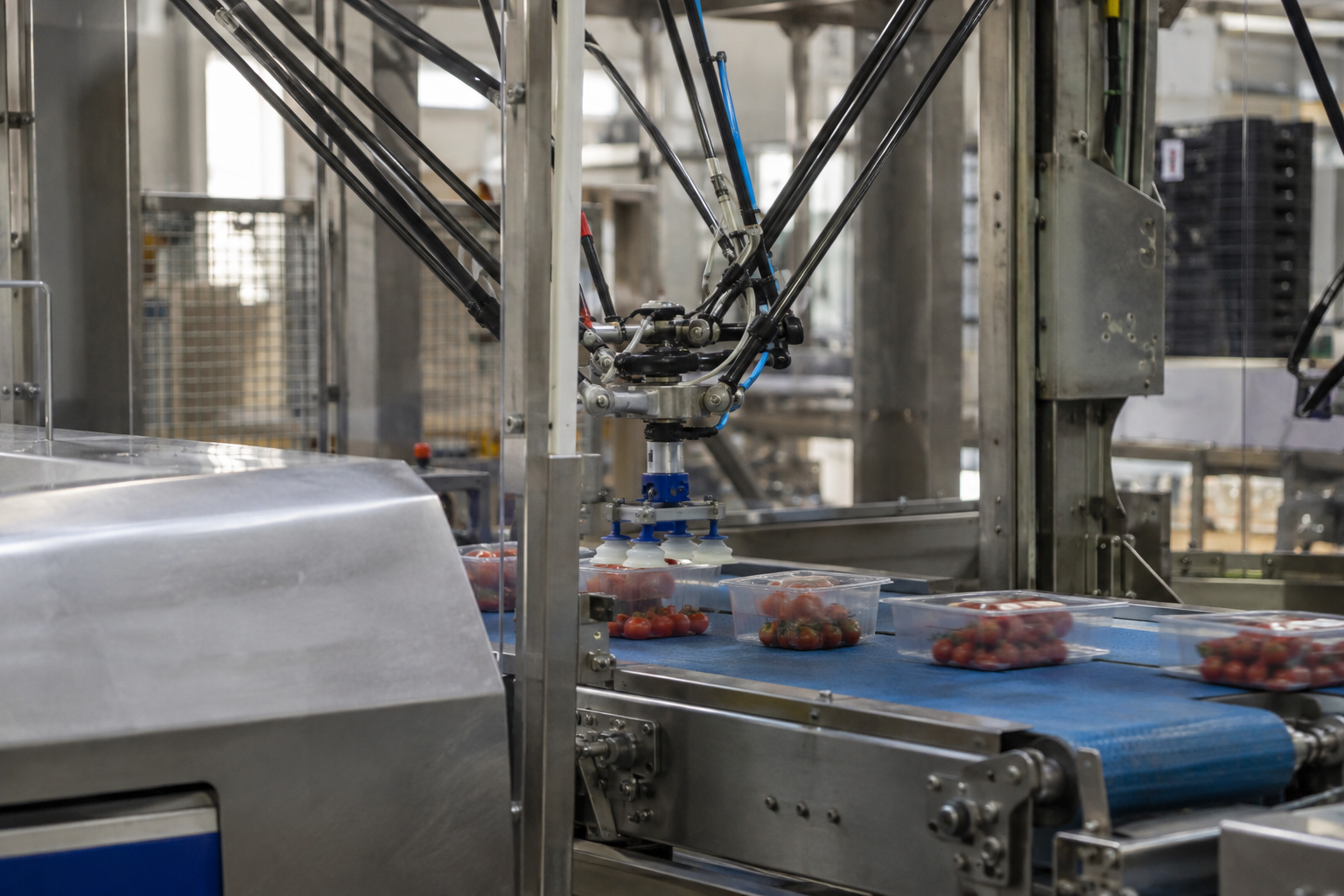
Q: What fits picking from moving conveyors, grouping and loading trays, cups or cartons?
A: Start with a delta robot system. Its stated applications connect the incoming conveyor task with the required output: pick products, form groups and load trays, cups or cartons. That makes it a relevant option when products must be collected from a moving stream rather than handed over in a finished group. Ask how product position will be established, what happens when a pick is missed and how incomplete groups will be handled. If the real task is loading prepared products into distribution cases, compare automatic case packing instead. Do not assume that suitability for conveyor picking confirms suitability for every downstream loading operation.
For changeovers, identify everything that changes with the product and destination pack: contact tooling, group count, orientation and loading position. Ask which adjustments are recipe-based and which require physical work. Where product residue is expected, review access to contact parts and the surrounding conveyor rather than discussing the robot alone. Integration should address product arrival variation, destination-pack availability and the response to a downstream stop. A useful buyer question is: Can the proposed arrangement demonstrate our least stable product and most difficult pack opening under representative conveyor conditions?
Q: What fits changing product mixes, delicate loading and vision-guided placement?
A: Consider a robotic pick-and-place system. These are the listed applications for this approach, making it a sensible starting point when product variety, gentle handling or placement based on visual information drives the decision. The critical discussion is how the product will be contacted, supported and released. Delicate loading is not confirmed simply by selecting a robot. Ask what visible damage, deformation or placement error will count as a failure. For moving-conveyor picking and grouping, compare the delta approach as well. The two categories have overlapping selection considerations, so the actual handling sequence matters more than the category name.
Changing product mixes calls for a detailed changeover review. Ask whether a new format needs different tooling, revised vision settings, a new placement recipe or changes to the product presentation. For vision-guided placement, include variations in appearance and orientation in the trial rather than relying on ideal samples. Review cleaning access around product-contact components and any areas where residue could affect observation or handling. Integration questions should cover missing products, uncertain detections and unavailable destination packs. This approach may not be the best starting point when the requirement is simply distribution case loading or finished pallet building.
Q: What fits loading products into distribution cases?
A: Start with automatic case packing, with top-load or side-load handling selected around the product and case format. This approach addresses the distribution-case loading task directly. Compare the loading directions by examining the case opening, product support and required final arrangement. Ask whether the product can tolerate the proposed loading motion and whether its orientation must remain fixed. If products first need to be picked from a moving conveyor and grouped, establish whether that is a separate upstream requirement. Case packing and conveyor picking can be successive operations rather than competing answers to the same question.
Bring the full product-and-case format list to the changeover discussion. Review changes to guides, loading components, product arrangements and case positioning without assuming that one adjustment covers everything. Cleaning requirements should reflect the product and likely debris, with access considered across the loading area. At the line boundaries, specify how products and cases arrive, how shortages are detected and what happens when either supply stops. Ask how the loaded case reaches the next operation and who defines that interface. Automatic case packing is not a substitute for palletizing, and it may be the wrong selection if the destination is a tray, cup or carton rather than a distribution case.
Q: What fits end-of-line pattern building and pallet handling?
A: Select a palletizing system for evaluation when the task is end-of-line pattern building and pallet handling. Start with the required pallet arrangement and work backward to the incoming load. Ask which patterns are required, how each load will be presented and what conditions make the finished pallet acceptable for downstream handling. Confirm the actual load dimensions, condition and variability during evaluation. A palletizing system addresses a different packaging stage from individual-product placement or case loading; it should not be treated as an alternative to either when those operations are still needed.
Changeover planning should include pattern selection, incoming load formats and pallet requirements. Ask what must be physically adjusted and how the correct pattern will be verified before production resumes. Review cleaning and debris-removal access alongside the normal operating sequence. Integration must include empty-pallet availability, incoming-load accumulation, completed-pallet removal and the response when any of those flows stops. Safe operator access and recovery from interrupted cycles also need a defined plan. The key buyer question is: Can the proposed layout support our pallet movement and operating procedures, not just build the requested pattern?
Final selection checklist
Before requesting a proposal, check that your brief answers these questions: What arrives at the station? What must leave it? Which products and packs are hardest to handle? What constitutes acceptable placement, product condition and pack quality? What changes between formats? How will operators clean, inspect and restart the station? What happens when the upstream or downstream process stops?
Pure Packaging Solutions engineers, specifies, supplies and integrates packaging equipment in the United States and Canada. A product and pack trial is needed to confirm suitability, using representative samples and agreed acceptance criteria. Include difficult formats and realistic presentation variation. Base the selection on that evidence, the proposed configuration and the complete line handoff, not on an assumed performance figure or a preferred robot category.