Start With the Load That Is Hardest to Handle
The limiting constraint in robotic palletizing is often the package, not the robot. A case that bulges after filling, a tray with an unsupported bottom or a carton with a porous top can determine the gripping method, allowable motion and stack pattern. Selecting equipment before understanding those conditions risks solving the wrong problem.
Build an application matrix covering every intended SKU, including package dimensions, weight range, closure method, incoming orientation and required pallet pattern. Record actual variation rather than relying only on packaging drawings. Include product temperature, condensation, dust and the condition of cases after upstream conveying.
Identify the combinations most likely to cause trouble. The heaviest case may govern payload, while the widest case governs clearance and the least rigid case governs gripping. Test production samples representing those extremes. Empty cartons rarely reproduce the behavior of filled packages.
Choose the Gripping Strategy Before Finalizing Robot Size
Four checks that connect package behavior to cell design
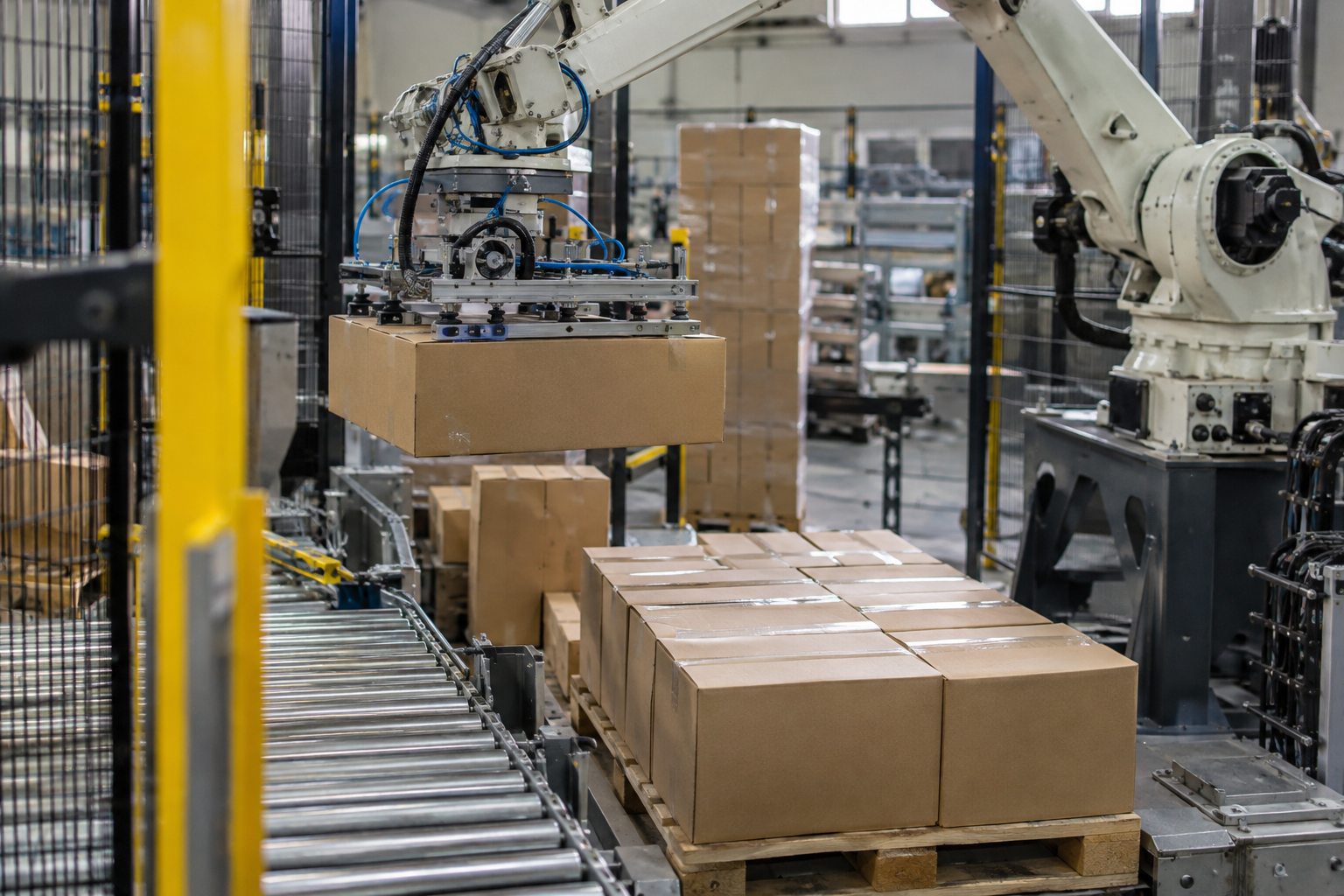
Decide whether to handle individual cases, grouped cases or complete layers based on the required flow and package characteristics. Larger picks can reduce placement events, but they also increase tooling demands and upstream accumulation. Evaluate the complete handling sequence, not just the loaded robot move.
- Validate the contact method. Vacuum requires suitable sealing surfaces and leakage tolerance. Clamps need surfaces that tolerate compression. Underneath support needs access for insertion and withdrawal without catching flaps or disturbing adjacent cases.
- Calculate the complete moving load. Include tooling, valves, brackets, dress components and every product carried together. Check the selected robot's allowable wrist moments and inertia, not payload mass alone.
- Check reach with the actual tool geometry. Model the pickup point, far pallet corners, maximum stack height and any slip sheet stations. Include clearance for tool release and withdrawal at every placement.
- Define how a grip is confirmed and lost grip is handled. Select sensing appropriate to the tooling, establish fault thresholds through testing and define a safe recovery sequence for retained, dropped or partially gripped product.
Size the Cell for Interruptions, Not Just Average Output
Average line output is a poor basis for cycle analysis when cases arrive in bursts. Use the fastest credible upstream discharge condition and map the complete cycle, including case preparation, picking, travel, placement and return. Add pallet exchange, slip sheet handling and any shared tasks. A robot serving multiple lines needs explicit arbitration rules when products arrive together.
Separate robot capacity from buffer capacity. Accumulation can absorb a short interruption, but it cannot compensate for a persistent throughput deficit. Estimate the cases generated during a pallet exchange or routine recovery, then determine whether the conveyor can hold them without crushing packages or blocking upstream equipment.
Ask what happens when a completed pallet is not removed. Define the warning point, the controlled stop sequence and the restart conditions. These decisions affect conveyor zoning, operator access and the signals exchanged with upstream machines.
Prove the Stack and the Access Plan Together
A pattern that fits the pallet geometrically is not necessarily stable or protective. Compare column and interlocked arrangements using the actual case construction and distribution requirements. Check overhang, gaps, weight distribution and compression near the bottom of the load. Include pallet dimensional variation and condition in placement tolerances.
Evaluate the load through discharge, wrapping and expected handling, not only while it sits in the cell. If stability depends on wrapping, examine the unwrapped transfer carefully. Slip sheets and top sheets introduce additional handling tasks that belong in the original cycle and layout study.
Plan personnel and forklift access at the same time. Locate pallet loading, clearing points and maintenance access without creating routine reasons to enter hazardous areas. Use an application risk assessment to define safeguarding and safety functions. A collaborative robot designation does not establish the safety of the complete palletizing application.
Make Recovery Part of Acceptance
Acceptance testing should cover more than continuous production with ideal cases. Include representative SKU extremes, pallet changes, interrupted picks, missing cases and restart from a partial pallet. Verify that operators can identify the fault and recover without guessing the robot's state or rebuilding the stack unnecessarily.
Agree on recipe ownership, changeover permissions, cleaning access, spare tooling components and backup procedures before commissioning. For a project review with Pure Packaging Solutions, visit the [Robotic Palletizing page](/robotics) and request a quote with your SKU matrix, layout and production constraints. Those inputs support a more useful discussion than a target case rate alone.